|
Studio MIYABI specializes in the care and
conservation of Asian scroll paintings. As you are
most likely aware, scroll paintings require a
particular type of expertise and specialized
skills. Traning for this type of conservation is
normally not available in the United states. Many
museums with large Asian collections staff their
conservation departments with Chinese or Japanese
trained conservators.
With few conservators trained to handle scroll
paintings, museums and private collectors with
special projects or small Asian collections often
have difficulty locating a conservator to help them
on a limited or short-term basis. Having recognized
and hoping to meet this need within the Asian art
community, I have established a conservation studio
that will offer conservation expertise on a
contractual basis.

ASIAN ART CONSERVATION IN AMERICA
By: Ryo Nishiumi
Over the years there have been numerous
Japanese screens collected by individuals and
museums in the West, especially in the United
States and Europe. As the screens age and need
restoration, it is becoming more and more
obvious that there is a shortage of conservators
in the West who are trained in the traditional
Japanese techniques of complete screen
restoration. In fact, today there may be less
than ten such conservators outside of Japan. In
addition, materials traditionally used for
screen restoration are often not available
outside the Orient. Of course it is hoped that
in the future there will be more Westerners who
are trained in traditional Japanese restoration
and that materials which are now difficult to
obtain will be more accessible. It can also be
expected that indigenous American and European
materials and methods will be substituted, by
those of us working in the West, for traditional
Japanese methods and materials whenever the
western methods and materials prove to be more
suitable. At my studio, for example, we are
exploring the use of Honeybomb (a man-made
hexongally-celled paper core) as a substitute
for the traditional wooden undercore of screens.
During the past 25 years of conservation
treatment in America, I have encountered many
problems. Some of the problems are easily solved
such as improper handling techniques and
incorrect temperature and humidity settings. The
more serious problems for me are related to
restoration techniques and materials. For
example, it is now easy but expensive to
purchase quality “washi” (paper);
however in America and Europe, to purchase the
wood for the screen’s undercore that
supports the six paper layers (which in turn
support the artwork) is still very difficult. In
Japan white cedar called “shiromi”,
Japanese cypress and “kiri”
(paulownia) are used for the undercores with
cedar being the most popular. Outside Japan it
is very difficult to obtain the
“shiromi” type of cedar. Therefore, in
the past, pine has substituted for Japanese
“shiromi” cedar both at the Freer
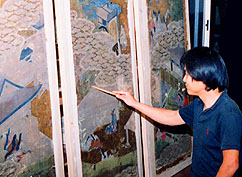
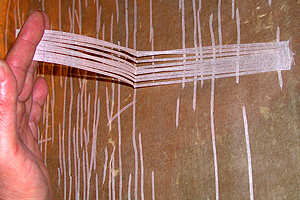
Gallery and at my studio. As shown in the
photograph there have been examples in which
acid from the replacement pine undercore has
damaged the painting. If at all possible a
screen’s old undercore is reused because
old cores give off virtually no acid.
Unfortunately sometimes because of severe damage
to the undercore, it must be replaced. This is a
problem for us because American woods are more
acidic than Japanese cedar, cypress or palownia
and are often milled differently. In addition,
in many parts of America and Europe finding a
carpenter who can build a traditional Japanese
style undercore is not always possible. For
these reasons I have begun experimenting with
adapting western conservation materials in the
restoration of traditional Japanese screens.
More specifically I have been looking for an
alternative to the screen’s wooden
undercore. Currently, we are using traditional
methods but substituting American poplar for
Japanese woods. The alternative we are looking
at now is a man-made material called Honeycomb.
Honeycomb has all the physical properties
necessary for a substitute for the traditional
undercore: it has the ability to expand and
contract with the changing temperature and
humidity; it is durable and resists warping and
it has an acceptable pH level. The advantages of
honeycomb are that it is easily accessible, can
be purchased locally and it is usable as is.
Only the addition of the paper for the hinges is
required without the necessity of applying six
layers of paper as a Japanese undercore would
require. Finally, it meets the same requirements
as a traditional Japanese undercore: namely, it
supports the artwork on a flat plane while at
the same time it absorbs excess moisture when
the humidity is high and on dryer days it
gradually releases moisture. Thus there are no
rapid changes in a screen’s moisture
content can often lead to either horizontal or
vertical tears. Two other important
characteristics that lead me to say that
Honeycomb appears to be an even better material
than the traditional Japanese undercore made
with an American wood, are that Honeycomb is
acid free and therefore presents no risk to the
artwork of causing acid burn and that it is less
attractive to insects.
Of course Honeycomb has not passed the final
test the test of time as have traditional
Japanese methods and materials. It is therefore
best to adhere to them as much as possible.
However when the necessity arises as it does
upon occasion for us in the west, we must be
willing to be inventive. Rather than be
discouraged by the lack of traditional materials
used in Japan, I think we can view the problems
that arise from doing Asian conservation in the
West as exciting challenges to be successfully
overcome. We will continue as much as possible
to follow traditional ways while being
constantly on the lookout for innovative
solutions to the problems that arise. Just as
many traditional Asian conservation techniques
and materials have been successfully adapted for
use in Western conservation so too is it
reasonable to expect that some Western methods
and materials will be successfully adapted for
Asian conservation.
|
|
Ryo
Nishiumi
- SUMMARY OF
QUALIFICATIONS
- Eleven years as Head of the East Asian
Painting Conservation Department at the
Smithsonian Institution, Freer Gallery of
Art.
- Completed ten years of apprentice system
at the Kyoto National Museum Conservation
Studio acknowledged by Education of Ministry,
Science and Culture of Japan.
- Restored Japan's first class National
treasures and Imperial collections.
-
- WORK
HISTORY
-
- Principal and
Director of Studio MIYABI, Fairfax, Virginia
1991 - present
-
- Conservation work for the private museums
including: Allen Memorial Art Museum,
Appleton Museum of Art, Cincinnati Art
Museum, Indianapolis Museum of Art, Lowe Art
Museum, Miami University Art Museum.
- Important restoration projects were a
pair of Tale of Gengi screen (18th
century), Rakuchu-rakugaizu byobu
screen (Views in and around the capital
of Kyoto, 18th century), and Korean
painting scrolls (early 17th century)
etc.
-
- Head of East Asian
Painting Conservation Department, Freer Gallery
of Art
1979- 1991
-
- Directed projects including the important
works of: Matsushima Screen (17th
century) by Sotatsu Tawaraya, Chu
Manuscript / the oldest existing silk
manuscript found in China, Restoration
of 19 scrolls and hand scrolls from the
permanent collections of The St, Louis Art
Museum.
-
- Chief of Staff,
Usami Conservation Studio / Kyoto National
Museum, Japan
1975-1978
-
- Directed work on Cultural Properties
including: Katsura Imperial Villa
(Japan's most Important 17th century cultural
treasure) comprehensive restoration project
including screen Paintings and wall
paintings, 13th century Imperial
collection hand scrolls, series of temple
wall paintings by Sosen Mori (Sosen's
oldest works), Hamamatsu screen (18th
century) complete restoration.
-
- Project Leader /
Staff Conservator, Usami Conservation Studio /
Kyoto National Museum
1968 - 1978
-
- Led the complete restoration of Japanese
screen doors (Fusumae) made by Kano
School (early 17th century) in Nishi
Honganji Temple, a designated first class
national treasure.
|
|